One day, two water worlds — and the missing middle between them
What connects the new water efficiency campaign (WEC), river activism and Andy Burnham MP’s call for place-based politics? Zoe McLeod argues that water reform needs a stronger “missing middle” between institutions, communities and the places people care about.
Last Thursday I found myself moving between two very different water worlds.
In the afternoon I was at Ofwat’s launch – or rather, pre-launch – of the new water efficiency campaign (WEC) which started yesterday. The meeting had originally been due to take place in person in Westminster, but was moved online because of the heatwave.
The session had a distinctly industry feel, chaired by Karma Loveday from The Water Report, with a speech from Ofwat’s CEO Chris Walters setting out the importance of the campaign with the growing scarcity of water. As I sat increasingly sweaty in my overheated kitchen, the formal tone felt very distant the world outside. Chris in a shirt, tie and blazer as temperatures pushed into the mid-thirties, although he was self-aware enough to comment on the potential oddness of his attire to the rest of us, from his air conditioned room in London.
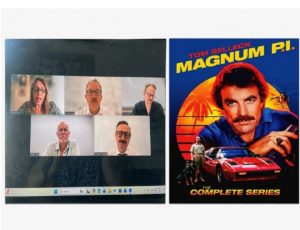
As part of the agenda, we were shown a video with a call to action Let’s ‘Save Water’, ending with the sort of closing montage any producer of the eighties show Dallas would have been proud of. I found a small moment of levity when the panellists popped up on screen sporting rather splendid Magnum PI style moustaches, perhaps leaving the Chair wondering if she had missed the ‘tash’ memo.
[Ofwat’s panel and the former Magnum PI Icon Tom Selleck – in case you are too young or aren’t familiar with the cultural reference]
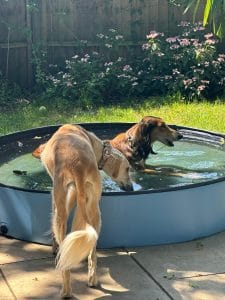
As I listened to the debate, I could see through the window my partner filling up the ‘doggy paddling pool’ (when did that become thing?) for the second time that week. And with it came a wave of shame, hypocrisy and recognition.
Because here’s the rub.
Asking people to cut water waste is achievable. The public generally do not like ‘waste’. Reducing leaks, avoiding unnecessary use and even fixing dripping taps – should be relatively easy to get movement on. Shifting water usage, including in the garden, may also be possible, assuming people have the flexibility to do so.
But asking people to reduce comfort, cooling or water-related leisure – baths, showers, paddling pools – is a much more of a challenge, especially during a heat wave and cost-of-living crisis when water is often a relatively low-cost pleasure.
Just ask my dog.
There was a suggestion from the audience that we need to make wasting water “as socially unacceptable as blowing smoke in a baby’s face”. I have some sympathy with the underlying point here – not, I should stress, the blowing smoke at babies – but the power of the “tuttage factor” and social normalisation should not be underestimated.
We were told this would be a positive campaign, not intended to shame people. Indeed the launch video is charming, warm, educational. It is designed to encourage us all to do the right thing and play our part. The campaign will rightly focus first on helping people understand why action is needed before building capability and showing people how they can act.
There were also practical and important questions to be answered. How do we ensure this campaign delivers value for money for customers? How will water savings be measured? How will the Water Efficiency Campaign (WEC) avoid double counting savings with other initiatives? How will it coordinate with water company activity? Will the narrative adapt to different regional contexts and different seasons? And critically, how will we ensure that during hot weather, people in more vulnerable circumstances do not over-ration water use – trying to ‘do their bit’ – when doing so could put them at risk of overheating or dehydration? This is an issue of particular interest for the consumer network ESAN that Sustainability First hosts and I chair.
Which leads to another important question: what is the governance around the campaign, and how do we ensure transparency and accountability to customers and stakeholders, including regarding these questions?
While some of the speakers appeared to want to avoid it, the elephant in the room was quickly uncovered: trust. Or rather, the lack of it. The most ‘liked’ audience question was linked to the challenge of shifting public behaviour in a context of low public trust – when company pipes are seen as leaking, industry is perceived as profiteering, regulation is seen by many as having failed, and myths about AI and water use are spreading fast.
Which takes me to my second water world.
Two hours later, I was at the rather trendy Conduit Club, talking to a passionate young environmental journalist before a panel discussion on whether rivers should have rights. This was a very different setting. The event began with a man in a straw hat reading poetry, followed by the chair playing the violin in a moment designed to reconnect us with nature. On the panel were activists, a journalist and an MP.
The rights of rivers were not presented as a single legal change, but as part of a much broader shift in how we value and protect nature. The love of rivers in the room was clear. But so was the adversarial tone – against water companies, regulators and the system as a whole.
There was outright disdain for the Environment Agency. There was talk of “luring” institutions into traps and “hammering them for their failings”. There was a call for friends of rivers to move from being citizen scientists – “doing the EA’s job for them” – to becoming ‘citizen investigators’, detectives hunting down the root cause of pollution and those responsible.
We heard how “the system” and “vested interests” treat rivers as assets or dead resources to be exploited. We heard how government fails to recognise our dependence on nature: “we need nature more than it needs us”. Also how industrialisation and even flood protections risk cutting people off from their ability to enjoy rivers. And, ultimately, we heard how activists feel that the legal and regulatory systems do not support them to achieve positive change. For those in industry or regulation, this kind of language can feel unfair, simplistic or uncomfortable. But it would be a mistake to avoid it.
Because for all the distance between these two worlds, both groups want versions of the same thing. They want a sustainable water system that supports people and nature to thrive. The activists seek instant agency. They believe they have a responsibility to take action. They talk about care, guardianship and sacrifice. Industry and regulators, similarly, want the public, businesses and landowners to take agency – to move from being passive users of water, or critics of water companies to playing their part in making things better through more water-efficient behaviour, less abstraction and less pollution.
As my Sustainability First colleague David Elliott often says, the river begins in our homes and businesses.
Both sides talk about stewardship. Both sides talk about the importance of storytelling — of helping the public and businesses understand why action is needed. Both sides believe climate impacts, alongside technological and social change, mean there is both a growing need and a growing opportunity to tell the water story differently so that it cuts through to shift public understanding and support for action so we all play our role in supporting the water system that sustains us. And yet both sit in increasingly polarised worlds.
Civil society groups are distrustful of companies and regulators. Industry and regulators fear activists. One side feels distant and technocratic. The other can sound angry, impatient and uninterested in complexity and practical barriers. One talks about regulation, incentives, delivery plans and behaviour change. The other talks about rights, justice, failure and moral urgency.
The question is: how do we build a bridge between these worlds? At Sustainability First, we believe there is a ‘missing middle’.
This is a catchment based approach to water and societal resilience where there is genuine collaboration. Not tick-box community engagement where consumer views have no influence and there’s no money for investment. Not a space that neutralises challenge or protects institutions and companies from criticism. But a missing layer of trusted, independent, place-based dialogue and decision-making that can bring together companies, regulators, communities, campaigners, landowners and local institutions around real rivers, in real communities with real trade-offs and concrete investment.
The current model too often leaves campaigners outside the room, shouting in through the window, while companies and regulators try to manage public engagement through carefully controlled processes. That does not work. It leads to low satisfaction, distrust and short-term low cost solutions that fail to deliver resilience and cost us all more in the long-term as well as fail to maximise benefits to communities.
If we want the public to play their part, they need to believe that others are playing theirs. If we want communities to move from anger to agency, they need routes into decisions that feel real. And if we want companies and regulators to rebuild trust, they need to engage not just with polished stakeholders who dance around their sensitivities, but with the messy, passionate, sometimes difficult world of people who care deeply about their rivers and disagree with them.
This is one of the reasons why Sustainability First is proposing a new decentralised water model: a catchment-level approach to regulation and governance that could help bring these parties together in new independent, community-led structures. The missing middle could reconcile all the factions and build greater empathy as all parties are more answerable and accountable to each other, rather than having the regulatory wall as the consumer proxy between their opposing camps. They could also develop community level strategies to boost water saving alongside national messaging. This approach would build on what Andy Burnham MP, former Mayor of Greater Manchester, and ‘King of the North’ understands. That place-based approaches can be unifying, powerful and tap into people’s sense of belonging and responsibility.
Which brings us back to the water efficiency campaign. Will it work? I hope so, especially as we pressed for this. The WEC team appears to have launched the campaign with its eyes open. It is clearly preparing for public pushback, particularly online, while at the same time looking to position this as independent from distrusted industry and regulators. Water companies are also saying the right things. The test will be whether they properly support the campaign in practice: sharing data, coordinating activity, aligning their own messages and activity. There is also plenty of low-hanging fruit in terms of water efficiency: reducing water waste, tackling customer-side leakage, improving non-household water use, and helping people understand the pressure on water resources and their own role in the water system.
But no one campaign can build understanding and trust on its own. The public will be more willing to save water if they believe companies are fixing leaks, regulators are enforcing standards, government is showing leadership, and polluters are being held to account. These factors are beyond the WEC’s control. People do not want to be told to take shorter showers while watching water pour down the road from a burst main. They do not want to give up small pleasures while believing others are profiting from failure.
So yes, the river begins in the home and with businesses. But it also begins with trust. And trust will not be rebuilt by communications campaigns alone. It will require a new place-based bridge between two water worlds that, for all their differences, may have more in common than either side realises.
Zoe McLeod is Co-Director /Associate at Sustainability First and a consumer and community advocate with more than twenty years’ experience in the water and energy sectors. To work with us or support us in developing a decentralised place-based water model please get in touch: zoe.mcleod@sustainabilityfirst.org.uk. Plus don’t forget to support the water efficiency campaign- Let’s Save Water | Water Efficiency Campaign for England & Wales – because we all need to save water (even my dog).
Fair for the Future ofwat Water Expert viewpoints